

The Problem Behind the Problem
For property owners throughout Marion County, a private septic system is the most critical waste infrastructure on the property. Yet, because the entire treatment network is buried completely out of sight beneath the lawn, it operates under an unfortunate rule: “out of sight, out of mind.” Many homeowners wait until a drain completely stops working, or until raw sewage forces its way into household bathtubs, before considering septic maintenance. This reactive strategy transforms a highly manageable, predictable maintenance routine into an expensive structural property disaster.
In 2026, managing private wastewater systems across Ocala and the broader 352 area code demands proactive precision. The underlying geology of Central Florida features highly porous limestone, which connects surface water directly to the Floridan Aquifer. If a septic tank is neglected, heavy solid particles escape into the surrounding soil, permanently clogging your absorption trenches and threatening local clean water sources.
Understanding exactly how often your specific household layout requires an engineering inspection and tank pump-out is not a matter of guesswork—it is determined by specific volume calculations, household occupancy numbers, and daily water-use habits. At Chad’s Water Works, we approach system longevity from an analytical perspective, helping you map out a precise care schedule to keep your infrastructure safe, compliant, and flowing reliably.
Section 1: Decoding the Maintenance Timeline Math
The most common question homeowners ask is a simple one: “What is the exact number of years I can wait before pumping my tank?” While the general industry baseline is 3 to 5 years, the actual scientific timeline is dictated by a balancing equation involving three distinct variables.
The Household Volume Formula
The speed at which solid waste builds up inside your concrete or fiberglass separation tank depends directly on three primary operational inputs:
    [ Household Size ]  +  [ Total Wastewater Flow ]  +  [ Solid Waste Volume ]
                                        │
                                        ▼
                  [ Dictates Your Custom Pumping Window ]
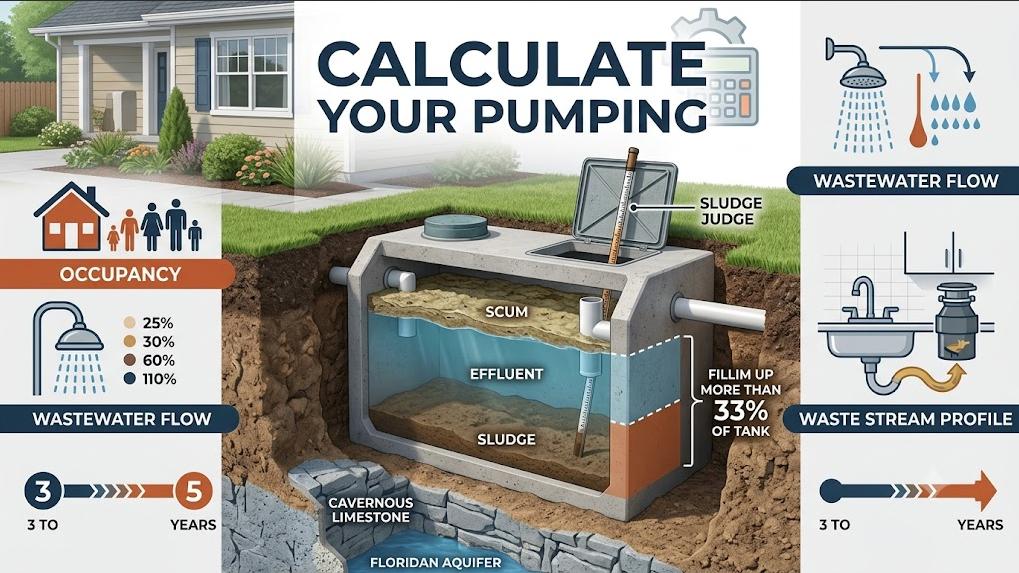
- Total Tank Capacity: A standard three-bedroom home in Ocala typically features a 1,000-gallon to 1,250-gallon septic tank. Smaller tanks have less retention space and require more frequent cleanings.
- Household Occupancy Count: A property with five active residents generates significantly more daily waste solids than a two-person household using the exact same size tank.
- The Waste Stream Profile: The specific types of waste introduced into your plumbing system completely change how fast solids pile up. Properties that rely heavily on garbage disposals, flush unapproved heavy paper products, or wash down heavy cooking greases will fill their storage chambers nearly twice as fast as homes that manage their waste carefully.
The “One-Third” Inspection Rule
Professional plumbers and state health inspectors use a strict volumetric standard to determine if a tank needs immediate pumping. When a technician opens your primary access lids, they use specialized measuring rods (often called a “Sludge Judge”) to measure the depth of the top floating scum layer and the bottom settled sludge layer.
If the combined thickness of the scum and sludge layers takes up more than 33% (one-third) of the total liquid depth inside your tank, the system must be pumped immediately. Waiting past this limit reduces the clear middle area of effluent water, causing solid particles to overflow directly into your drainage trenches.
Section 2: Why the Problem is Worse Than It Looks
When a septic tank is left un-pumped past its threshold, the damage that occurs does not stay confined inside the concrete box. The real breakdown happens in the surrounding yard area, where repairs are incredibly disruptive and expensive to execute.
The Mechanics of Drainfield Clogging
When a tank fills up with solid waste, the exit pipes begin carrying tiny, suspended organic particles out into your yard’s absorption lines. These lines are wrapped in protective stone layers and designed to allow filtered liquid to soak naturally into the ground.
As solid particles slip past the tank, they act like a thick glue, sealing up the open pores in the soil and blocking the tiny slots in your disposal lines. This process suffocates the natural soil bacteria and creates an impermeable layer that blocks water from draining. Once the soil becomes completely sealed, wastewater is forced upward to the surface, creating muddy puddles, foul odors, and eventual indoor drainage back-ups.
Garbage Disposals and Mechanical Stress Factors
Many homeowners do not realize that kitchen garbage disposals are one of the leading causes of early septic system failure. A disposal does not dissolve food waste; it simply chops it into tiny, heavy solids that sink straight to the bottom of your septic tank.
Food waste does not break down as easily as human waste, which quickly overloads the tank’s natural bacteria and shortens your pumping window by up to two full years. If your home has a busy kitchen disposal, scheduling an inspection every 18 to 24 months is essential to track solid build-up. For homes dealing with slow interior kitchen or main line drains, our crew provides comprehensive cleaning solutions detailed at our Professional Drain Cleaning and Maintenance Support page.
⚠️ Homeowner Warning: The Myth of “Septic-Safe” Flushable Wipes
Many retail bathroom products are prominently labeled as “flushable” or “septic-safe.”
Our professional directive is absolute: Never flush thick wet wipes, heavy paper towels, or feminine hygiene products into a private septic system. Unlike standard toilet paper, which is engineered to dissolve within seconds of hitting water, these synthetic wipes use reinforced fibers that can remain fully intact inside your tank for years. They do not break down naturally, they quickly clog internal entry baffles, and they fill up your tank’s storage capacity ahead of schedule. Protecting your system requires flushing only human waste and standard toilet paper. For comprehensive line inspections, check out our solutions at theGeneral Plumbing Services and Leak Preventionpage.
Section 3: The Chad’s Water Works Standard
When you partner with Chad’s Water Works for your scheduled septic care, you are choosing a team with a reputation built on safety, transparency, and elite craftsmanship.
  🥇 "BEST OF THE 352" GOLD WINNER (2024 & 2025) 🥇
───────────────────────────────────────────────────────
  Verified Licensing  •  2026 Florida Building Code Compliance
Award-Winning Community Focus
We are incredibly honored to be voted the “Best of the 352” Gold Winner for both 2024 and 2025. This title represents our team’s daily commitment to providing honest, flat-rate pricing, clear technical explanations, and high-quality work to every customer across Ocala and surrounding Marion County neighborhoods. We don’t believe in quick fixes; we focus on long-term safety and reliable system performance.
Complete Code and Environmental Compliance
Every septic service, system pumping, and line repair we perform is completed in absolute compliance with the 2026 Florida Building Code and local county health regulations. Our service standards guarantee:
- Eco-Friendly Processing: We transport and dispose of all septic waste at state-approved treatment facilities that meet strict environmental guidelines.
- Detailed Permit Tracking: Our crew manages all necessary municipal permits and county health paperwork, keeping your home fully compliant with local codes.
- System Protection Protocols: We inspect structural tank baffles during every pump-out to ensure your system stops solids from escaping into your yard.
- Validated Technical Standards: We consistently follow industry updates from trusted national authorities, including the International Association of Plumbing and Mechanical Officials, accessible at IAPMO.
Section 4: What to Expect: The Client Journey
We know that arranging utility or plumbing service can break up your normal day. That is why we use an organized, professional process to keep you fully informed from the moment our truck arrives to the final safety walk-through.
[1. Precision Tank Locate] -> [2. High-Capacity Vacuum Pump] -> [3. Component Safety Check]
Step-by-Step Service Delivery
- Precision Tank Location: Our crew arrives in a modern service truck, uses electronic sensors to map out your tank without damaging your landscaping, and reviews clear, upfront pricing options with you.
- High-Capacity Vacuum Pumping: We carefully open your tank’s main access lids and use our heavy-duty vacuum system to remove all liquid, floating scum, and packed bottom solids completely.
- Component Safety Check: We clean your tank’s internal pre-filters, run a camera check on the entry and exit baffles, and run a flow test to verify that your home’s lines are draining smoothly before sealing the lids.
Real Success in Our Community: A Silver Springs Shores Case Study
A homeowner in Silver Springs Shores recently realized they had living in their home for over four years without ever pumping or inspecting their septic system. While they weren’t experiencing an active backup, they noticed their guest bathroom toilet was gurgling whenever the washing machine completed a spin cycle. They reached out to our office to set up a preventive safety check.
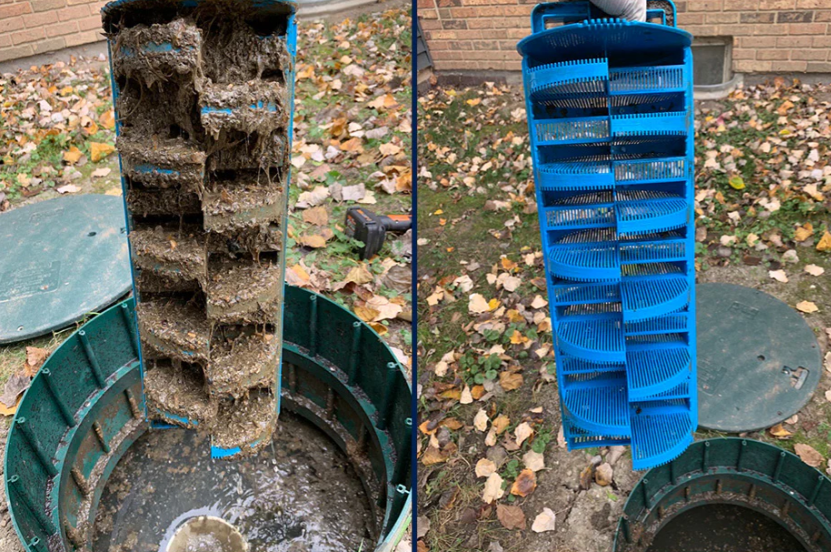
Our service truck arrived on-site and our crew uncovered the main access risers. Our measuring rods revealed that the bottom sludge layer had risen to take up nearly 45% of the tank’s capacity, and the internal effluent filter was heavily coated in grease and hair.
Our team completely pumped out the tank, thoroughly cleaned the reusable blue plastic pre-filter, and ran a high-definition video check on the exit line. Thanks to catching the issue early, the gurgling stopped completely, the lines returned to full drainage speed, and the absorption field was protected from a costly failure. If you have an aging gas water heater that needs a routine safety check or replacement after completing plumbing repairs, check out our options at our Professional Gas Safety and Specialized Piping Support section.
Section 5: The Real Cost of Waiting
Delaying basic septic care—like putting off a routine pump-out or ignoring a gurgling pipe—can quickly turn a manageable maintenance call into an expensive property emergency.
Financial Scenario Analysis: Proactive vs. Reactive Paths
The table below outlines three separate maintenance paths, illustrating the real financial benefits of staying ahead of your septic care.
| Service Factor | Proactive Scheduled Service | Delayed Emergency Pumping | Full Drainfield Overload & Failure |
| Primary Service Cost | Standard flat-rate maintenance rate | Emergency dispatch fees + overtime labor | Massive replacement expense (excavation, new soil, new field) |
| Indoor Structural Damage | $0.00 (all cleaning remains outside) | Minimal (minor cleanup in low shower drains) | Severe (major indoor sewage extraction, mold mitigation, restoration) |
| Landscaping Impact | Minimal (neatly opening access lids) | Moderate (extended yard traffic and service lines) | Heavy (complete excavation of yard, new soil, new lawn seeding) |
| Local Code Status | Fully compliant with health codes | High risk of emergency code citations | Mandatory county health permitting and full environmental review required |
| Household Convenience | 1 to 2 hours (scheduled at your convenience) | 24 to 48 hours under highly stressful conditions | Days to weeks without working plumbing during full yard excavation |
Protecting the Floridan Aquifer and Home Value
Ignoring necessary maintenance can lead to serious legal and financial issues with local health authorities. Because Marion County sits directly over the delicate Floridan Aquifer, county health officials monitor environmental complaints closely. A neglected system that leaks raw sewage onto the surface can lead to official citations, expensive daily fines, and can even cause the home to be declared unlivable until the entire network is dug up, replaced, and passed by county inspectors.
Taking care of regular pumping helps you avoid unexpected red-tag shutdowns, protects our shared drinking water supply, and keeps your property value secure. If your home’s main lines have been under stress from a backed-up tank, explore our full system repair options at our Sewer Repair and Structural Pipe Restoration portal.
Section 6: Improving Your Infrastructure: Advanced Treatment Upgrades
While sticking to a consistent pumping schedule is essential, many homeowners choose to improve their water quality to protect their plumbing lines and support their septic system’s natural balances. This is especially true in Ocala, where our groundwater contains exceptionally high levels of dissolved calcium and magnesium.
HARD WATER INFLUX (Disrupts Natural Tank Processes):
[High Mineral Scaling] ──> Packs Sludge Layer ──> Limits Bacterial Breakdown

MODERN WATER SOFTENING UPGRADE (Protects Infrastructure):
[Ion-Exchange Filtration] ──> Eliminates Scaling ──> Keeps System Healthy and Balanced
This hard water creates rock-hard mineral scale inside your water heater, appliances, and distribution pipes. When this mineral-heavy water drains into your septic tank, it can cause the solid sludge layer to pack together tightly, making it much harder for natural bacteria to break down waste effectively. Installing a high-efficiency water softening system helps protect your home and your septic network by:
- Eliminating Hard Mineral Scale: Keeps your valves, interior lines, and faucets completely clear of calcium build-up.
- Supporting Bacterial Breakdown: Balances the chemical properties of your wastewater, helping helpful microbes break down solids efficiently.
- Maximizing Appliance Lifespan: Protects your water heater and laundry systems from early failure while matching strict environmental criteria managed by the Environmental Protection Agency, which you can read about at EPA WaterSense.
To see how a modern water treatment upgrade can protect your plumbing infrastructure and support your system’s health, visit our specialized solutions at our Water Softener Installation and Treatment Options portal.
Conclusion: The Fix Starts with a Call
Your home’s private septic network is a major asset that keeps your living environment safe, clean, and comfortable. Staying ahead of solid waste build-up, using garbage disposals carefully, and sticking to a 3-to-5-year pumping window are essential steps to avoid unexpected backups and protect your property value.
               CHAD'S WATER WORKS PROMISE
────────────────────────────────────────────────────────
  24/7 Emergency Response  •  Expert Code Compliance
  Gold-Winner Standards    •  Upfront, Transparent Estimates
Whether your system is showing clear warning signs of age, your pipes are gurgling, or you simply want to set up a reliable maintenance schedule to protect your home, our award-winning crew is here to help. As your trusted “Best of the 352” Gold Winner, we bring certified expertise, upfront pricing, and a commitment to